

There’s a question that keeps coming up in the security world, and it’s time we stop tiptoeing around it. Many professionals wonder whether they should stay completely off social media to protect their privacy and clients, or if it can actually be used as a marketing tool to build credibility and attract business.
In an industry built on confidentiality and professionalism, the rise of personal branding and online visibility has created real confusion. We’re living in a time where social media shapes how the world sees us, and it’s also become a free marketing tool available to everyone. You no longer need to pay hundreds or thousands of dollars to be featured in a newspaper or magazine just to be seen by the public. You can now do it yourself and for free!
Algorithms reward exposure, but the security profession demands discretion, and being able to find the balance between the two has never been more challenging. Today, clients don’t just look for competence; they look for visibility and reputation. If they can’t find you online, they often assume you don’t exist, or you are not credible enough to get their business.
At Mellon360°, we see this conflict all the time and we’ve seen both sides, those who fear exposure and choose total invisibility, insisting, “If you’re in security, stay off social media,” and those who treat it like an open stage, posting every detail and believing, “Post whatever you want, it’s all marketing.”
We’ve all seen it: a selfie from a client’s jet, a photo taken outside a private estate, or a “behind-the-scenes” video that reveals far more than it should. It may look professional to outsiders, but to anyone who understands risk, it’s a red flag. These kinds of posts don’t communicate expertise or professionalism, they communicate carelessness. They signal a lack of judgment and a breach of client confidentiality and OPSEC.
Both extremes miss the point, and both can damage your reputation in very different ways.
Why Staying Invisible in Today’s World Can Hurt You
For decades, security professionals have been taught that anonymity equals professionalism. The less people know about you, the safer you are. That mindset made sense in an analog world, when referrals came by phone call or post mail and credibility was built through handshake reputation.
But the world has changed. The days when a business card or a handshake defined your credibility are gone. Today, Google is your business card. Your LinkedIn profile is your handshake.
Your digital footprint is now part of your professional identity. Clients, partners, and recruiters check LinkedIn and Google before they ever pick up the phone. How many of you have noticed the “Add your LinkedIn profile URL” field in job applications over the past few years? It’s now practically required on every form, because it matters in the hiring process.
If your name doesn’t appear anywhere credible online, they don’t assume “discretion.” They assume you don’t exist.
There’s a big difference between being discreet and being invisible. Discretion is knowing what to share; invisibility is refusing to participate. One builds trust, the other erases you.
Being invisible doesn’t communicate professionalism; it communicates uncertainty, or even nonexistence. Sad, but true. People want to see that you exist, that you understand the industry, and that you can communicate without compromising operational security.
In times where clients make decisions in seconds, first impressions happen online. A strong, well-managed presence doesn’t just make you look credible; it gives you a competitive edge.
At the end of the day, digital presence is professional presence.
The Dangerous Flip Side of Oversharing
Then there’s the other extreme, professionals who post everything. And when we say everything, we mean everything!
We’ve all seen it: selfies during assignments, photos in front of clients’ estates, trip itineraries, “day-in-the-life” reels from protection details, or brags about who they’re guarding.
That’s not marketing. That’s operational negligence. When the very person hired to mitigate risk starts broadcasting sensitive details online, they’re no longer an asset, they’re a liability and the ones creating risks. And while those posts might get likes (from your auntie Carol or the girl you met at the bar last week), they quietly destroy trust and credibility with serious clients.
Remember: UHNW families, executives, family offices and corporate security teams are not impressed by attention-seekers. They trust the ones who show restraint, discretion, and professionalism even online.
So, what’s the answer? The balance lies in strategic visibility, being present, intentional, and credible online without compromising integrity and OPSEC.
Our team at Mellon360° doesn’t just understand marketing, we live and breathe the security world. With decades of operational and corporate experience behind us, we’ve built an entire framework that merges marketing intelligence with security awareness. We call it Security-Conscious Marketing™, and it’s how we help security professionals, companies, and training institutions grow their visibility without creating vulnerability. We know the difference between exposure and visibility, and we help our clients walk that fine line with confidence.
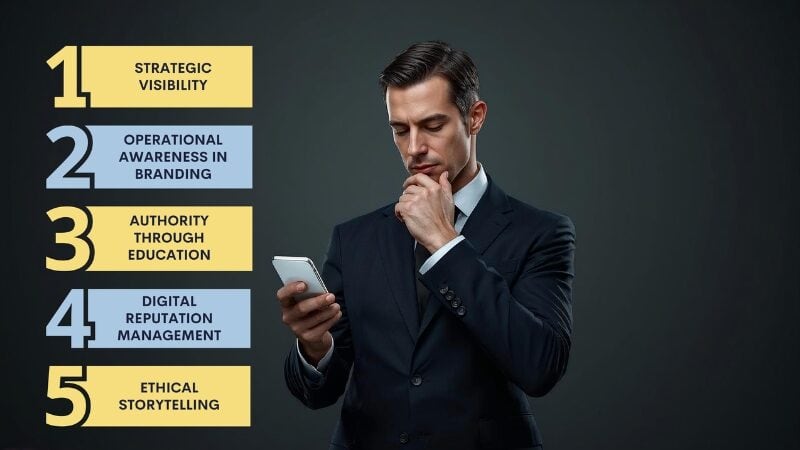
Here’s how it works:
- Strategic Visibility – Build awareness without overexposure. Every post, photo, and caption should inform, educate, or position you. Never reveal sensitive details.
Visibility should build trust, not invite scrutiny. For example, instead of posting a photo from a client’s location or event, post a thought-provoking opinion about risk assessment, leadership, or situational awareness. Share why preparation matters, not where you are. Your presence online should tell people you’re an expert, not where to find you or who your client is… - Operational Awareness in Branding – Apply the same OPSEC mindset you use in the field to your online activity and marketing. Every piece of content should pass the “risk filter” test before it’s posted.
Blur any backgrounds, crop parts of the photo that would give away sensitive information or identifiers. For example, before uploading a photo, look at the background, does it show a house number, car plate, or recognizable landmark? Remove it or blur it. Avoid timestamps, identifiable routes, or personal schedules. Remember that what you post stays in the digital world forever, and what’s harmless to you might be goldmine of information to someone with bad intentions. - Authority Through Education – Authority doesn’t come from telling people who your clients are, how much they worth or what kind of luxury life you live through your clients. It comes from showing what you know. Learn to replace ego with insight.
Share lessons learned, best practices, and industry observations from your experience in a way that educates without exposing. For example, instead of posting “Just finished a detail with XYZ high-profile client,” post “5 things I’ve learned about managing client’s logistics.”
The difference here? One sounds like self-promotion and a lot of bragging (and no one likes those who brag). The other will position you as an expert worth listening to and learning from. - Digital Reputation Management – Your digital footprint is an extension of your professional credibility. Make sure it reflects who you are today, not who you were five years ago. Remember that your online presence should reinforce trust.
Clean up outdated profiles, control your narrative, and make sure Google results reflect your credibility. For example, clean up outdated bios, inactive pages, and low-quality posts. Update your LinkedIn with relevant experience, certifications, and achievements that align with your current direction. Regularly Google your name and see what comes up first. That’s your first impression to clients, partners, and recruiters. Control the narrative before someone else does. - Ethical Storytelling – Focus on what’s valuable to your audience, not what flatters you. “Here’s what I learned” goes much further than “Look who I protected.” Or ‘’Look my feet up on a private jet seat’’…
Great marketing tells stories that inspire trust and show education and do not beg for attention. The key is to shift from the mentality of “look what I did” to “here’s what I learned.” For example, instead of posting a photo inside or next to client ‘s private jet or yacht, write a short story about a challenge you overcame, without naming names or exposing details. Talk about communication under pressure, resilience, or professionalism in uncertain environments. These insights show depth and attract quality clients who value integrity over noise.
Why It Matters?
It matters because today we live in a world where social media and AI-generated noise dominate the conversation. Everyone’s talking, but only few are saying something meaningful. Authenticity has become the new currency and, in an industry built on trust, that matters more than ever.
For professionals in the security and protection industry, digital literacy is no longer optional. Understanding how to present yourself online is just as critical as how you present yourself on the ground. Your digital footprint tells potential clients how you think, how you communicate, and how seriously you take discretion. And the key is to treat social media as part of your risk management plan, not your ego management plan. Every post, photo, or comment should go through the same security checklist you’d apply in the field: Does it protect the client? Does it protect my reputation? Does it serve a purpose? If not, it doesn’t belong online.
Reputation and discretion aren’t opposites; they’re partners. You can’t have one without the other. Clients expect you to be visible enough to show credibility, yet discreet enough to prove you can be trusted. When done right, social media doesn’t threaten your professionalism, it reflects it. It becomes a mirror of your knowledge, discipline, values, and leadership.
So, if you’re still wondering whether to post or not to post, here’s our answer: post, but post smart. Post with strategy, awareness, and intention.
Because in this business, your reputation doesn’t just follow you, it precedes you. And remember, the people who lead this industry aren’t the loudest, they’re the most consistent, credible, and clear. The same discipline that keeps you sharp in the field should guide how you show up online.
And if your marketing agency doesn’t understand NDAs, OPSEC, or confidentiality, they don’t understand you.
At Mellon360°, we speak security. We help you build a brand that commands respect, attracts the right clients, and protects your reputation at every digital touchpoint.
Contact Mellon360° to schedule your consultation today.